While waiting for a train, you may have noticed yellow rectangular devices installed between the rails. They look small and unimportant — fixed in place, easy to cover with snow, seemingly insignificant. But in reality, these devices play a crucial role in railway safety. What are they?
If you watch old films, you’ll see how many people once worked directly along the tracks. Not just in train stations, but out on the line itself: raising barriers at level crossings, throwing switches with long levers, selling tickets at every larger stop, and passing vital information to train drivers. Today, nearly all of that is automated. And those yellow rectangles between the rails are part of that automation.
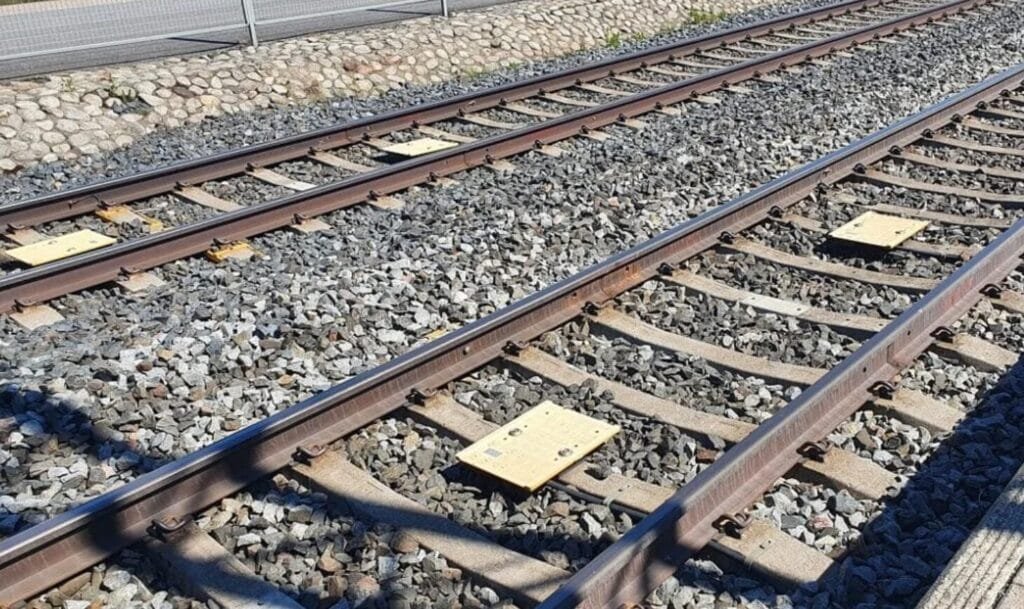
These are balises — railway transponders used in modern signalling systems. They communicate with a train’s onboard computer through antennas mounted underneath the train. There are several types of balises, and their exact use varies by country and signalling system, but they are generally divided into fixed‑information and variable‑information balises. Their purpose is usually the same: to ensure safe train operation.
What information might a train need? Balises can tell the train and its operator the precise location, warn of an upcoming curve, tunnel, or speed‑restricted section, or confirm that a speed limit has ended. For example, if a sharp curve is ahead, the train may need to slow down. Operators change, routes are long, and no one can memorize every detail of every line. GPS and trackside signs help, but balises provide highly reliable, standardized information directly to the train’s systems. Variable‑information balises can also transmit temporary changes, such as new speed restrictions or altered track conditions. Modern locomotives interpret this data automatically and take appropriate action — including reducing speed if necessary. Some balises can even receive information (such as the train’s speed, for use in traffic management systems) though this is less common.
Balises are usually installed in pairs, spaced about 2-3 meters apart. This helps the train determine whether the information applies to its direction of travel. A “1–2” sequence might indicate that a speed restriction is approaching, while “2–1” signals that the restriction has just ended.
Interestingly, most balises have no power source. They are energized by the train’s onboard reader as it passes over them — the same principle used by contactless bank cards, which transmit data without their own battery. Balises are programmed during installation unless they are variable‑information units, which are more complex and do require their own power supply.
Railway balises are simple devices, and that simplicity makes them extremely reliable. With no batteries, they are unaffected by moisture. They have no moving parts. There is very little that can fail. And in case a balise does malfunction or is physically damaged, the train and driver rely on other signalling systems. A thin layer of snow or ice does not interfere with balise’s function. Modern balises can even be read by very fast trains — up to 500 km/h. The critical electronics are on the train; the balise itself is essentially a rugged plastic module containing a few lines of important data.